

Available for Pearl Voice only.

Adding the Node
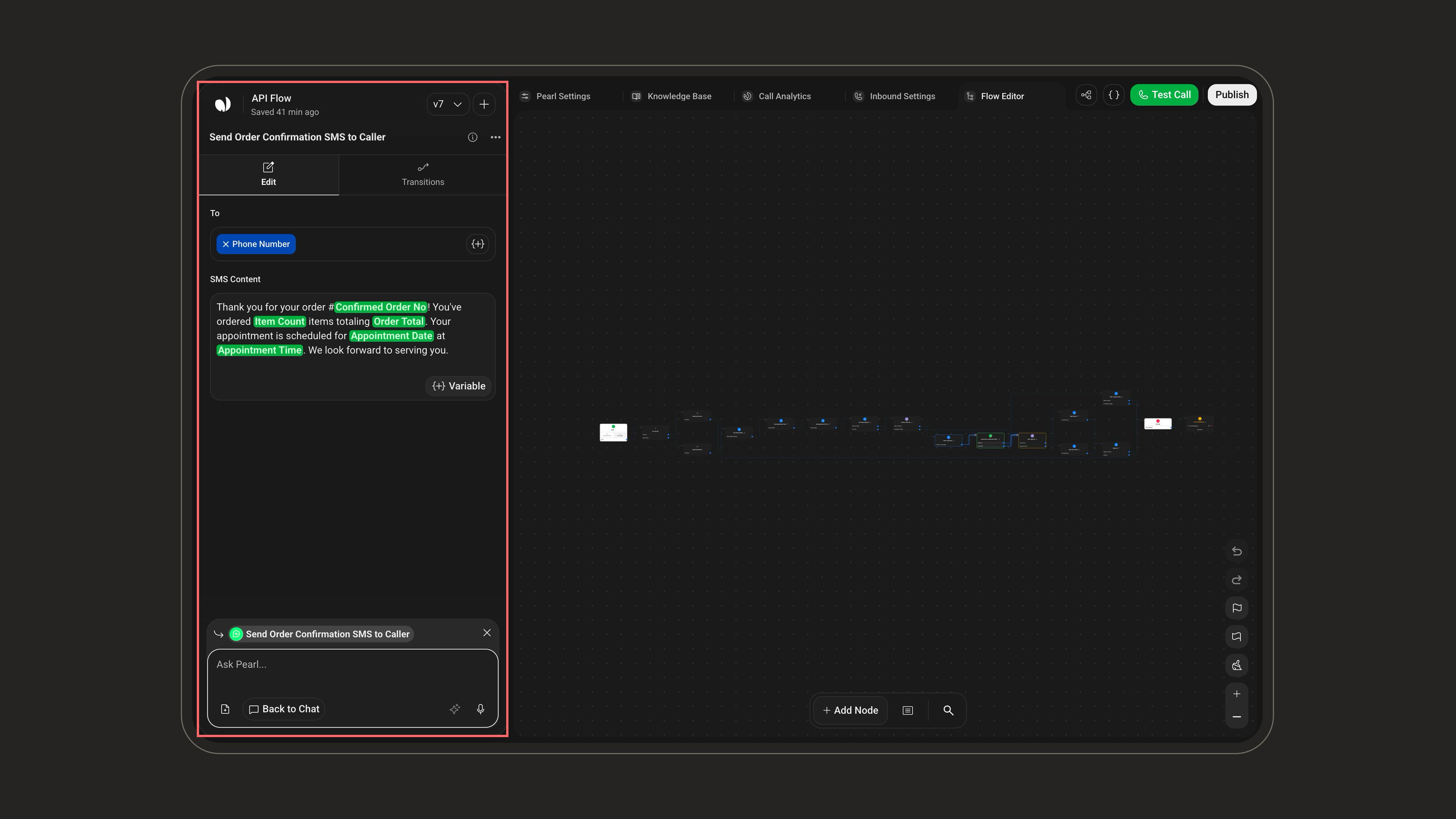
In the Flow Editor, add a Send SMS node where you want the message to be sent.The SMS is sent based on where the node sits in your flow, there is no separate trigger field on the node itself.
Fields to Configure
1
To
The recipient phone number(s), entered as tags. At least one recipient is required, and you can mix both modes below in the same field.Send to the customer (dynamic) — Insert the built-in phone number variable with the variable picker. At send time it resolves to the number of the person on the call, including the country code (e.g. Accepted format: an optional leading
+1 234 567 8900), and is stored as {phoneNumber}. This is the most common setup: the SMS goes to the customer you’re talking to.Send to a fixed number (static) — Type a number and press Space or Enter to turn it into a tag. Use this to always notify the same destination (an internal team, a manager, a back-office line), whoever is on the call.Only the built-in phone number variable can be inserted here. Custom variables (including numbers collected during the call) are not available in the To field, only static numbers or the customer’s phone number. This mirrors the Email node’s To field, which only accepts the email address variable.
+ followed by 1 to 20 digits, with no spaces, dashes, or parentheses. Invalid entries are rejected and not added as a tag.2
SMS Content
Write the message to send. You can include links and details, and insert variables to personalize it, for example:
Hi {firstName}, your reservation at {restaurantName} is confirmed.Available variables depend on where the node runs:Regulatory compliance — To stay compliant, Pearl always asks the customer for consent before sending an SMS, respecting their preferences and communication laws.
Example Use Cases
Reservation confirmations
After confirming a reservation, Pearl automatically sends an SMS with the details.
Appointment reminders
Pearl sends a reminder SMS about an upcoming appointment or event.
SMS Credit Cost
Sending an SMS consumes credits from your account balance. The cost depends on:
- Recipient country: each destination has its own rate per segment.
- Number of segments: longer messages are split into multiple segments, each billed individually.